
VoteReady
One household. Different voter situations. One clear action plan. A synthetic prototype combining multilingual AI assistance with deterministic rules and explicit citizen confirmation.
- Type
- Synthetic civic-tech prototype
- Role
- Full-stack & AI engineering
- Source
- GitHub ↗
- Visit
- Live product ↗
Tech stack
- Next.js
- React
- TypeScript
- Supabase
- PostgreSQL
- Prisma
- Gemini
- Zod
- Playwright
- Vercel
 Next.js
 React
 TypeScript
 PostgreSQL
 Prisma
 Gemini
 Vercel
A household needs more than one status
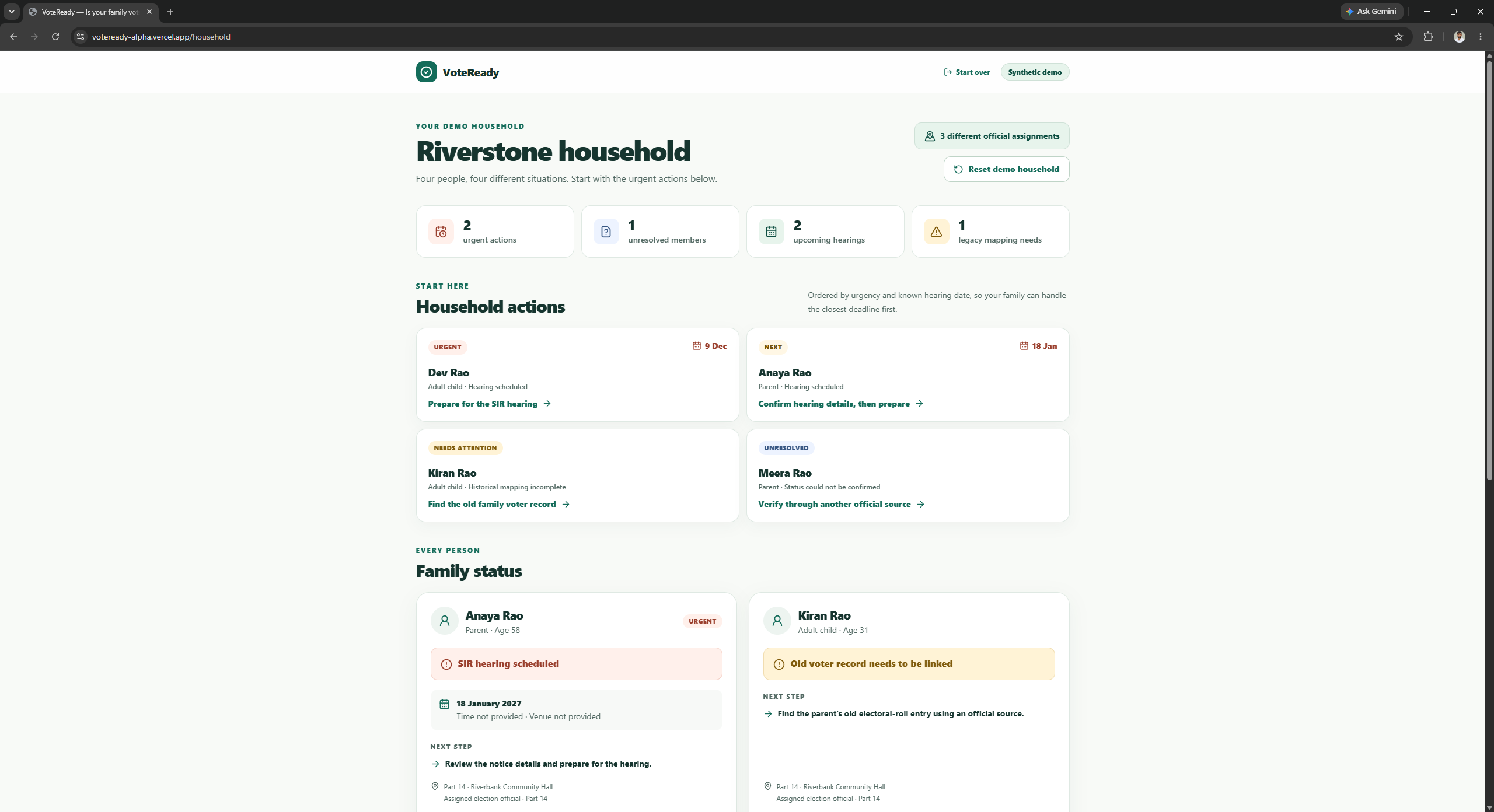
A family can share an address while its members face very different voter-record situations. A single household-level status hides the difference between a scheduled hearing, an unresolved current record, and a historical record that still needs matching.
VoteReady checks each member independently and turns those situations into a prioritised action plan. The demonstration follows four fictional people across three official assignments, with separate record, notice, and preparation states.
AI interprets. Rules decide.
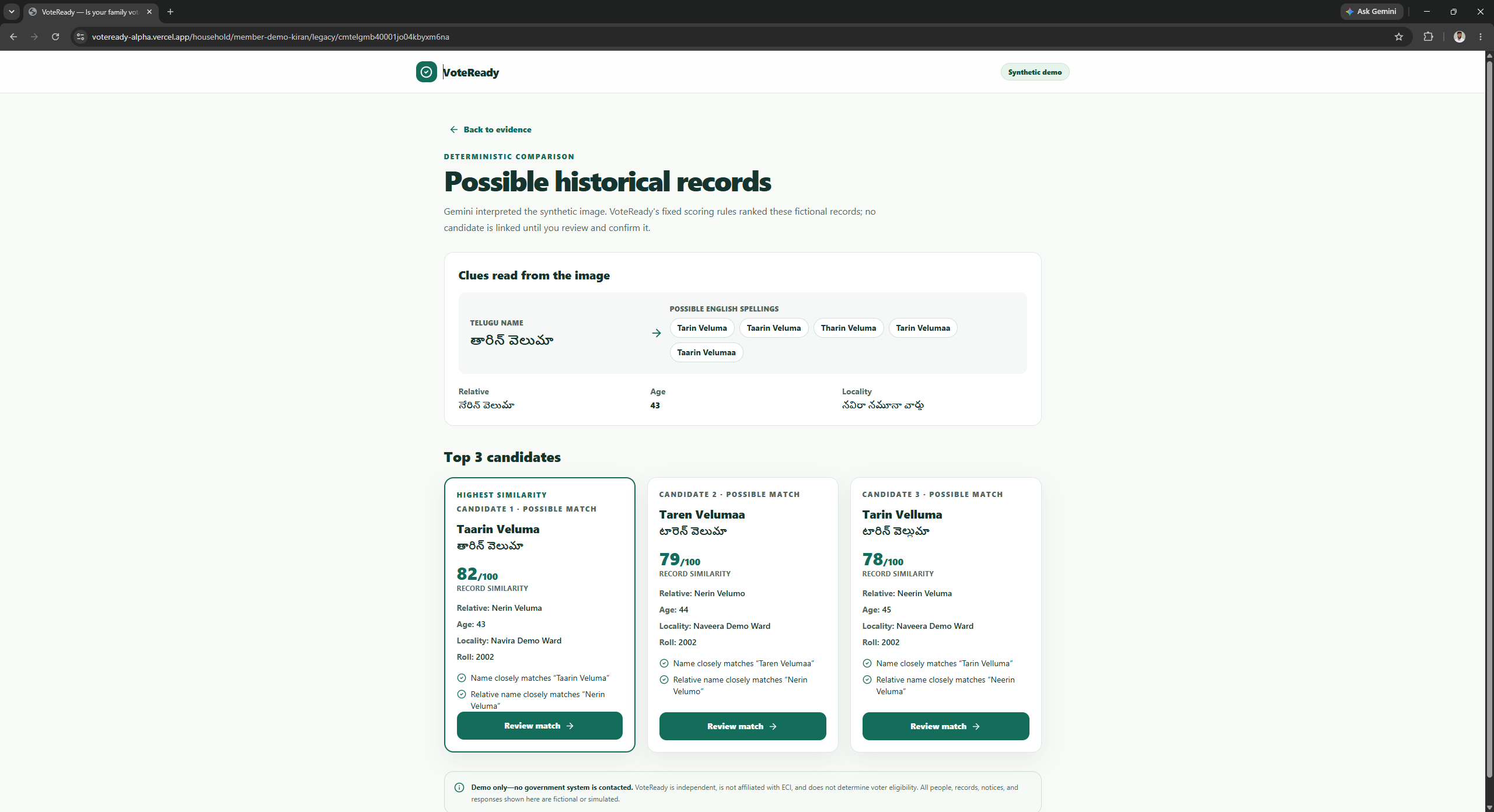
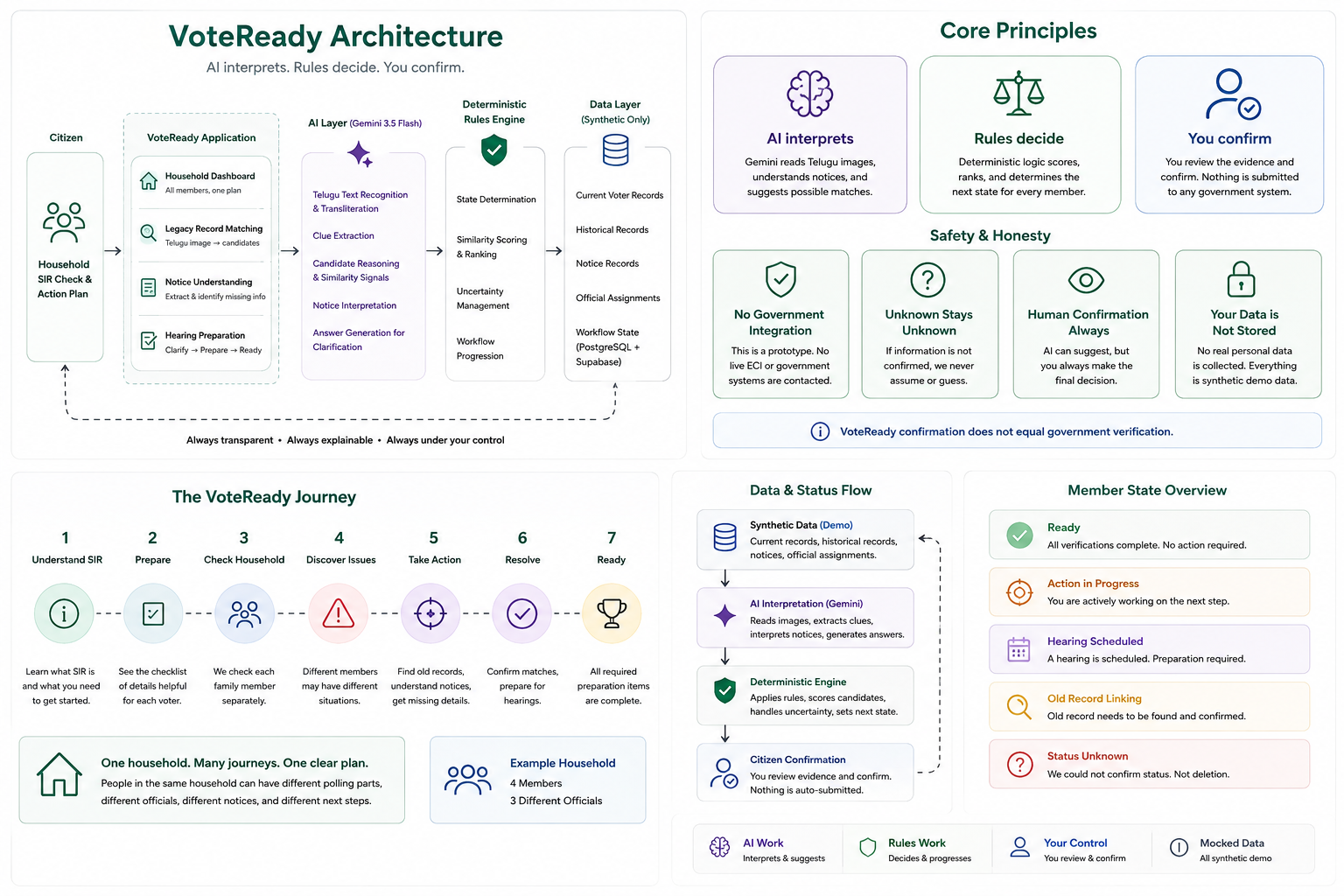
The application separates interpretation from decisions. Gemini reads visible clues from a Telugu historical roll and returns bounded English transliterations. Zod validates the structured output before deterministic rules rank possible matches.
The fixture produces similarity scores of 82, 79, and 78 out of 100. These are rule-based ranking scores, not identity probabilities or confidence that a person has been found. The citizen must explicitly confirm the candidate.
Keep missing information missing
An incomplete notice leaves four important fields unknown: the reason, time, venue, and evidence requirements. The application preserves those unknowns instead of filling them with plausible instructions.
A separately labelled simulated clarification can supply the missing details and three preparation items. Their provenance remains visible, so extracted notice content and simulated follow-up information stay distinguishable.

From interface to persistent workflow
Next.js, React, and TypeScript provide the application interface. Supabase PostgreSQL and Prisma persist household and workflow state, while Gemini supplies bounded interpretation behind structured schemas.
The repository documents an end-to-end build with Codex, including the application, validation gates, and deployed workflow checks. Session persistence allows the demonstration to continue after a reload.
Trade-offs
| Choice | Reason | Boundary |
|---|---|---|
| Synthetic records and simulated responses | Demonstrate the full workflow without using real voter information. | Results do not establish real-world electoral accuracy. |
| Deterministic ranking after AI interpretation | Keep candidate ordering inspectable. | Ranking quality still depends on extraction quality and the chosen rules. |
| Explicit citizen confirmation | Make identity selection a deliberate action. | The demo cannot verify a real person’s identity. |
| Structured output and preserved unknowns | Constrain the interface and expose missing information. | Schema validity alone does not prove factual correctness. |
What the checks demonstrate
The README reports the following checks for the synthetic demonstration. These validate implementation behaviour against fixtures, rather than voter eligibility or accuracy on real electoral records.
| Reported check | Result |
|---|---|
| Unit tests | 53 / 53 passed |
| Browser end-to-end tests | 11 / 11 passed |
| Public deployed workflow checks | 10 / 10 passed |
| Observed browser console errors | 0 |
| Responsive viewports | 375, 430, 1280, and 1440 px |
| Missing notice fields preserved as unknown | 4 / 4 |
The fixture contains four household members, two notices, four open actions, and fifteen historical records. Typecheck, lint, build, database, and privacy checks were also completed before deployment.
Next questions
The next evaluation step is a larger synthetic multilingual set, measuring Top-1 and Top-3 matching accuracy, extraction precision and recall, false inferences, and schema validity.
AI request latency is another documented limitation. Repeated p50 and p95 latency and cost measurements would be more useful than treating the README’s single-run observations as a performance guarantee.
FAQ
Is VoteReady an official government service?
No. It is an independent synthetic prototype with no ECI affiliation or government-system connection.
Do I need to enter real voter information?
No. The demonstration uses fictional people and records. Its credentials, notices, and official responses are simulated.
Does AI choose a person’s identity or eligibility?
No. AI interprets visible clues, deterministic rules rank candidates, and a citizen explicitly confirms a selection. The prototype does not determine eligibility.
What do the test results measure?
Application behaviour on synthetic fixtures, browser workflows, and deployment checks. They do not measure accuracy against real electoral records.